
Contractor Induction Software
Contractors can bring specialist skills, extra capacity and project flexibility into a workplace. They may carry out maintenance, construction, cleaning, security, repairs, inspections, transport, facilities work, IT installation, electrical work, event support, refurbishment or short-term project tasks.
However, contractors also create a management challenge.
They may not know your site. They may only attend for a short time. Some may work outside normal hours. Others may arrive through subcontracting chains, labour hire arrangements or specialist service providers. Even when a contractor is highly experienced, they still need to understand the risks, rules, access arrangements and reporting expectations that apply to your workplace.
That is why online induction training for contractors is becoming a practical part of contractor management for UK businesses.
Instead of relying on rushed site briefings, printed forms or repeated conversations at reception, an online contractor induction gives external workers the information they need before they arrive. It also gives your organisation a clearer record of who completed training, when it was completed, what documents were supplied and whether further action is needed.
Induct For Work helps UK businesses create, send and track contractor inductions from one platform. Contractors can complete training from a phone, tablet or desktop computer, while administrators can manage records, documents, expiry dates, reports and site requirements in a more organised way.
Why contractors need to be inducted
A contractor induction is not a formality. It is a practical step that helps an external worker understand how to enter, work and behave safely at your site.
HSE guidance says everyone who works for an organisation needs to know how to work safely and without risk to health, including contractors and self-employed people. It also says workers must be given clear instructions, information, adequate training and supervision.
For construction projects, HSE’s CDM guidance says contractors must ensure workers under their control have a suitable site-specific induction unless this has already been provided by the principal contractor. Contractors also have duties to plan, manage and monitor their work so risks are controlled.
In simple terms, experience alone is not enough.
A contractor may know their trade, but they still need to know your workplace rules. They need to understand site access, emergency arrangements, first aid, reporting procedures, restricted areas, PPE expectations, traffic routes, permits, welfare facilities, hazards and who to contact if conditions change.
A good contractor induction helps reduce assumptions.
What online contractor induction should cover
An online contractor induction should be relevant to the work, site and level of risk. It should not be a generic presentation that everyone clicks through without understanding.
Useful contractor induction topics may include:
- company and site overview
- arrival, parking and access rules
- sign-in and sign-out requirements
- site contacts and supervision arrangements
- emergency procedures
- first aid arrangements
- fire and evacuation instructions
- restricted areas
- PPE requirements
- traffic management and pedestrian routes
- plant, equipment and machinery rules
- permit-to-work requirements
- working at height controls
- hot works controls
- electrical safety expectations
- hazardous substances or COSHH instructions
- lone working arrangements
- incident, hazard and near-miss reporting
- environmental requirements
- waste management
- behaviour, drugs and alcohol expectations
- mobile phone and photography rules
- welfare facilities
- site-specific hazards
- document and licence requirements
HSE’s construction site induction guidance also highlights topics such as project management, first aid, accident and incident reporting, toolbox talks, consultation and individual responsibility for health and safety.
The aim is not to overload contractors with unnecessary information. The aim is to give them the right information before they start work.
The problem with manual contractor inductions
Many businesses still manage contractor induction manually.
A contractor arrives onsite. Someone looks for the correct form. A supervisor delivers a quick briefing. The contractor signs a paper sheet. Documents are emailed later. A spreadsheet is updated if someone remembers. When an audit, client request or incident occurs, the business has to search through folders, inboxes and filing cabinets.
That process can create risk.
Manual contractor induction often leads to:
- inconsistent information between sites
- repeated briefings that depend on who is available
- missing signatures
- incomplete document checks
- expired licences or insurance records
- unclear contractor approval status
- lost paper records
- poor visibility across locations
- no clear record of content version
- no quiz or understanding check
- delayed access at the gate or reception
- weak evidence during an audit or incident review
A manual process may feel simple at the start, but it becomes difficult to manage when contractors, sites and documents increase.
Online induction training creates a more consistent process. Contractors receive the required information before they attend. Administrators can track completion. Site teams can check status. Records stay connected to the user.
Who this page is for
This page is for UK businesses that use contractors and need a more reliable way to manage induction, documents and training records.
It is especially useful for:
- construction companies
- principal contractors
- facilities management teams
- manufacturing sites
- warehouses and logistics operators
- schools and education providers
- local authorities
- health care and support services
- event venues
- shopping centres
- office-based businesses using maintenance contractors
- charities and non-profit organisations
- transport companies
- cleaning companies
- agricultural and seasonal workplaces
- multi-site organisations
The common issue is the same: contractors need clear instructions, and the organisation needs proof that those instructions were provided.
Contractor pre-qualification before induction
Contractor induction should not always be the first step. For some businesses, contractor pre-qualification should happen before training or site access.
Pre-qualification helps confirm that a contractor has supplied the required information before work begins. This may include insurance, licences, certificates, risk assessments, method statements, RAMS, trade qualifications, business details and other required documents.
A pre-qualification process can help answer questions such as:
- Is the contractor approved to work with us?
- Has the required insurance been supplied?
- Are licences or certificates current?
- Has the contractor provided the right documents for this type of work?
- Are expiry dates being monitored?
- Has the contractor completed the correct site induction?
- Is further review required before work starts?
Induct For Work’s contractor pre qualification feature can support this process by helping businesses collect information before contractors are allowed to proceed.
This creates a better workflow: approve the contractor, assign the right induction, collect required evidence and track completion in one place.

Site-specific contractor induction
A contractor who is trained for one site may not be ready for another.
Different sites can have different hazards, access rules, emergency arrangements, traffic routes, permits, welfare facilities, working hours and contact people. That is why site-specific induction is important.
For example:
- a maintenance contractor at a school may need safeguarding, visitor access and restricted area rules
- a cleaner in an office may need out-of-hours access and alarm instructions
- a delivery driver at a warehouse may need traffic route and loading bay rules
- an electrician at a manufacturing site may need isolation, permit and machinery instructions
- a contractor at an event venue may need crowd movement, emergency and public access information
- a subcontractor on a construction site may need project-specific controls, site rules and supervisor details
Induct For Work allows businesses to create different induction pathways for different sites, contractor types and risk levels. This helps avoid a one-size-fits-all induction that gives some contractors too much irrelevant information and others too little useful information.
Role-based contractor training
Contractors should not all receive the same training if their work is different.
A delivery driver, scaffolder, cleaner, IT technician, maintenance engineer, security guard, plumber, electrician, groundskeeper and catering contractor may all need different instructions.
Role-based contractor training can include:
- general company induction
- site-specific induction
- trade or activity-specific instructions
- document upload requirements
- quiz or pass mark
- licence or certificate request
- policy acknowledgement
- refresher schedule
- supervisor approval step
A contractor working in a higher-risk environment may need more detailed training and document checks. A low-risk escorted visitor or occasional service provider may need a shorter, proportionate process.
This makes induction more useful because the content matches the work.
Collecting contractor documents
Contractor induction often fails when training and documents are managed separately.
A contractor may complete an induction but still have missing insurance. Another may supply a licence that has expired. A subcontractor may provide documents by email, but those files may not be connected to the person’s training record.
Induct For Work can help collect and manage contractor documents, including:
- public liability insurance
- employer’s liability insurance
- trade licences
- training certificates
- competency evidence
- right-to-work documents where relevant
- risk assessments
- method statements
- RAMS
- permits or access documents
- company policies and declarations
- vehicle or plant information
- site access forms
Where expiry dates apply, the system can help administrators monitor renewals. This reduces the risk of a contractor being treated as approved when key records are missing or outdated.
For stronger document control, link contractor induction with document registry, record keeping and reporting.
Quizzes, pass marks and understanding checks
A contractor induction should not only prove that someone opened the course. It should also help confirm that the person understood the key information.
Quizzes and pass marks can support this.
A short quiz can test important site requirements such as:
- emergency assembly point
- PPE requirements
- incident reporting process
- restricted areas
- permit requirements
- traffic routes
- contact person
- sign-in and sign-out rules
- what to do if conditions change
- where to report a hazard
Induct For Work supports quizzes so businesses can add knowledge checks to contractor training. Contractors can be required to meet a pass mark before the induction is marked as complete.
This helps reduce “tick and flick” training and creates a clearer completion record.
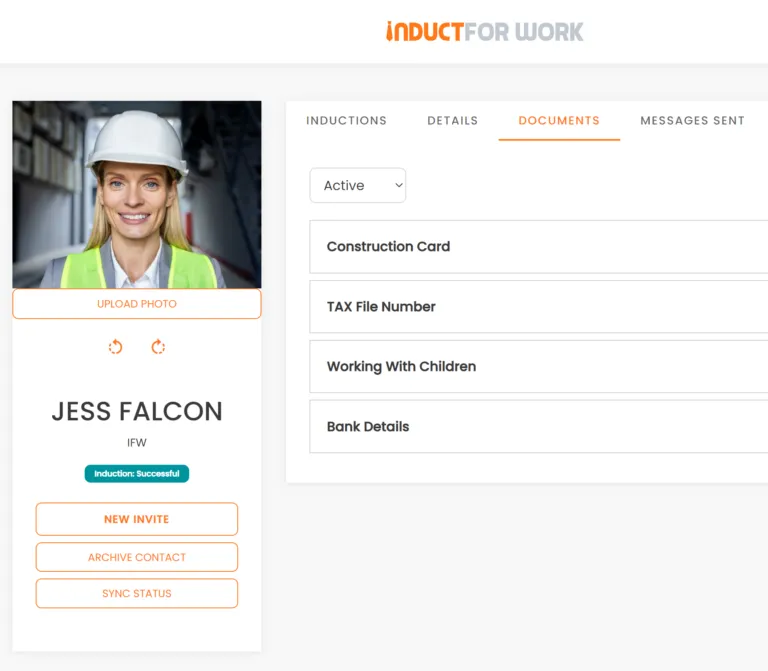
Contractor certificates and access status
Once a contractor completes the required steps, the business may need evidence of completion.
Certificates can help workers, supervisors and administrators confirm that training has been completed. However, a certificate should not replace proper access control or document checks. A contractor may have completed training but still need licence approval, document review or site supervisor clearance.
A strong contractor process should show status clearly.
Examples include:
- invited
- started
- completed
- failed quiz
- awaiting document review
- document expired
- approved for site access
- refresher due
- suspended or not approved
This makes it easier for site teams to check whether a contractor is ready to work.
Incident and hazard reporting for contractors
Contractor safety does not end after induction.
Contractors also need to know how to report incidents, hazards, near misses, unsafe conditions and changes in the work environment. If they do not understand the reporting process, important information may be missed.
A contractor induction should explain:
- what must be reported
- who receives reports
- how urgent issues are escalated
- how to report a hazard or near miss
- what to do after an injury
- whether photos or supporting details should be attached
- how follow-up will be handled
Induct For Work’s incident reporting UK feature can support this process by giving workers and contractors a digital way to submit reports. This helps businesses capture information while details are still fresh.
Where concerns relate to work pressure, bullying, aggression, conflict or poor support, businesses may also benefit from psychosocial hazard reporting.
Toolbox talks and contractor refreshers
Some contractor training is needed before work starts. Other training needs to happen during the job.
Toolbox talks, safety updates and refresher modules can help keep contractors informed when site conditions change.
Useful refresher topics include:
- traffic changes
- weather risks
- updated emergency procedures
- new restricted areas
- incident learnings
- seasonal safety reminders
- changed working hours
- revised permit rules
- manual handling reminders
- public access changes
- client requirements
Induct For Work can help issue updated information and keep records of who received it. This is useful for multi-site organisations, project work and contractors who return regularly.
Multi-site contractor management
Contractor induction becomes harder when a business manages several sites.
A contractor may be approved for one location but not another. One site may require additional PPE. Another may have different emergency arrangements. A third may need extra document checks because of the type of work being performed.
Multi-site contractor management should allow businesses to:
- separate contractors by site
- assign site-specific inductions
- create different user groups
- control administrator access
- review records by location
- check completion before arrival
- monitor documents across sites
- standardise core content while adding local rules
Induct For Work supports multi-site workflows by helping businesses manage training, records and reporting across different locations.
This is especially useful for businesses with offices, depots, warehouses, schools, venues, projects, facilities or regional teams.
Contractor induction for different industries
Contractor induction is useful across many UK industries, not only construction.
Construction and trades
Construction sites often need detailed site inductions, permits, RAMS acknowledgement, PPE rules, traffic management, work at height controls and emergency instructions. HSE says site rules should cover topics such as PPE, restricted areas, hot works, traffic management, fire prevention, permit-to-work systems and emergency arrangements.
Facilities and maintenance
Facilities contractors may need access information, out-of-hours rules, plant room restrictions, isolation steps, sign-in requirements and emergency contact details.
Warehousing and logistics
Contractors and visiting drivers may need traffic route instructions, loading bay rules, pedestrian safety information, vehicle movement controls and reporting processes.
Schools and education
Contractors attending schools may need safeguarding expectations, visitor access rules, restricted area instructions, site contacts and emergency procedures.
Events and venues
Event contractors may need crowd management information, setup and pack-down rules, emergency procedures, restricted areas and public access controls.
Health care and support services
Contractors working in care or health settings may need infection control, visitor access, confidentiality, safeguarding and emergency procedures.
A flexible online induction system allows each industry to build training around its own risks.
How Induct For Work helps
Induct For Work helps UK businesses manage contractor induction, contractor training records and contractor document collection from one platform.
Your organisation can use it to:
- create online contractor induction courses
- assign training by site, role or contractor group
- invite contractors by email or SMS
- collect documents before work starts
- track induction completion
- add quizzes and pass marks
- issue certificates of completion
- monitor document expiry dates
- set refresher training schedules
- manage contractor records
- review reports
- support incident and hazard reporting
- create different pathways for different sites
- keep evidence organised for audits and reviews
Instead of managing contractor induction through paper forms, spreadsheets and inboxes, Induct For Work helps bring the process into one controlled workflow.
A practical contractor induction workflow
A simple contractor induction workflow may look like this:
- Add the contractor or contractor company to the system.
- Request required documents, licences, certificates or insurance.
- Review contractor pre-qualification information.
- Assign the correct site-specific induction.
- Require a quiz or knowledge check where needed.
- Confirm induction completion.
- Issue a certificate or completion record.
- Approve access when all requirements are met.
- Send refresher training when required.
- Monitor incidents, hazards, documents and expiry dates over time.
This process gives administrators a clearer view of contractor readiness and gives contractors a better experience before they arrive.
Make contractor induction easier to manage
Contractors need clear information before they start work. Businesses need evidence that the right information was provided, the right documents were collected and the right people were approved.
Online induction training for contractors helps solve both problems.
It reduces repeated briefings, improves consistency, supports site-specific training, helps collect documents and gives administrators clearer completion records. For UK businesses managing contractors across one or many sites, this can save time and reduce confusion.
Induct For Work gives your organisation a practical way to manage contractor induction, pre-qualification, records, reporting and refresher training in one platform.
When contractors arrive informed, documented and ready, site teams can focus less on chasing paperwork and more on managing work safely.
Frequently asked questions
Online induction training for contractors is a digital training process that gives contractors the information they need before starting work or entering a site. It can include site rules, safety procedures, emergency instructions, PPE requirements, document requests, quizzes and completion records.
Contractors need induction training because they may not know the specific risks, rules, access arrangements and reporting procedures for your workplace. A contractor may be experienced in their trade but still unfamiliar with your site.
UK employers must provide workers with clear information, instruction, training and supervision, including contractors and self-employed people. In construction, HSE guidance says contractors must make sure workers under their control have a suitable site-specific induction unless already provided by the principal contractor.
A contractor induction should include site access, emergency procedures, first aid, PPE, restricted areas, traffic routes, incident reporting, site hazards, permit requirements, supervision arrangements, behaviour expectations and any role-specific controls.
Yes. Online contractor induction allows contractors to complete required training before they arrive onsite. This can reduce delays at reception, the gate or site office.
Yes. Induct For Work can help collect documents such as insurance, licences, certificates, RAMS, risk assessments, method statements and other contractor records.
Yes. Contractors can be assigned different induction pathways based on site, role, trade, risk level, location or project requirement.
Yes. Induct For Work can support refresher training, reminders, updated safety modules, toolbox talks and recurring training requirements for returning contractors.
Start a free trial or book a demo to see how INDUCT FOR WORK UK can support your workplace induction training processes.
Author: Mick S Brown
Published: 26/11/2026
Updated: 14/07/2026